Monday, July 6, 2015

Nanocoatings in Oil and Gas


Nanocoatings are nanosized particles comprised of some sort of mineral or chemical that’s usually painted onto a surface, generally being an appliance of some sort, to aid the device in a wide assortment of functions. The following is a list of several types of nanocoatings and what those coatings can do to make a device or object stronger or more dependable.

Anti-corrosion Coatings
Anti-corrosion coatings are nanocoatings that allow an object, generally being iron or steel in nature, to resist corrosion from air or even water. By applying anti-corrosion nanocoatings to a object, you not only make it stronger but increase that object’s expected lifespan greatly. Anti-corrosion nanocoatings help the oil industry because the giant drills, wells, and processing factories are often based deep in ocean waters and even in the thrashful environment of strong river currents. Because of this, the metals that make up the equipment in the oil industry often become corroded quickly and the machinery begins to break down. 

Lubricant Coatings
Lubricant nanocoatings are also very benefitial to oil industry as a whole due to the fact that, even though the machines can be prevented from corroding, the metal parts are constantly moving and these large, heavy pieces often slide against each other, which can not only create that dreadful nails-on-a-chalkboard sound but also damage the machinery. The lubrication provided by lubricant nanocoatings is far stronger than any WD-40 can provide and keeps the machinery at top-notch performance for as long as needed.

Thermal Coatings
Thermal nanocoatings provide the machinery of the oil industry with the protection it needs from geothermal conditions that could literally melt the metal of the drills and other equipment that is necessary to the extraction of oil from the Earth. Often times, these machines have to work for long periods of time far below the Earth’s surface in order to get to the oil. Because of this, thermal nanocoatings help aid the equipment with the defenses required to withstand both the heat and pressures found at those levels.

Anti-fouling Coatings
Whenever you have something made of metal underwater, whether it is a machine, ship, facility, or whatever, bacteria and plants often cling onto the metal and over a long period of time, these bacteria and plants accumulate in large numbers and can impair the performance of that machinery (for example, ships with a large accumulation of bacteria and plants on its hull can increase the fuel requirements of the vessel). Anti-fouling nanocoatings provide the metal with a protection against these things and help the oil industry tremendously due to the fact that oil wells almost always venture underwater to extract the oil. 

Nanotechnology-Based Filtration
Whenever you are wanting to extract a specific material from the Earth, you almost always have to deal with unwanted materials that are swarming around the material that you want. This is no different in the oil industry. Often times when oil companies extract oil from the ground or underwater, they must deal with gases, metals, water, and many other types of invasive substances that are sitting in the oil. Because of this, the oil industry has had to come up with a variety of methods to clean out all of the excess materials that they don’t want in order to get pure oil. One of these methods is nanotechnology. The following is a short list of the types of nanotechnology-based filtration systems that have become part of the oil industry.

Gas Separations
One of the problems with extracting oil from deep beneath the Earth is that in the same areas that the oil accumulates, so do other gases that we may or may not want, but gases that we definitely do not want mixed in with the oil. Because of this, nanotechnology applications have been devised to separate these gases from the oil on a molecular level so that there are no leftovers even on such a small level. This is highly important because even extremely small materials that get mixed in with the oil can ruin the entire barrel and cause devastating effects if that contaminated oil were ever used.

Heavy Metal Separation
Another big problem with extracting oil from the beneath the Earth is that there are heavy, liquid metals, such as iron, that are floating around in the same area as the oil and can often contaminate the entire mixture. That’s why scientists have devised methods to use nanotechnology to separate these metals from the oil at a molecular level. This is a very good thing because you definitely don’t want to be pumping liquid oil into the gas tank of your car or rubbing some other heavy metal into your skin, such as can be found in the use of petroleum jelly.

Oil-water Separation
The last example on this list, but by no means the least, is the separation of water from the oil – or to be more exact, oil from water. Water, while not exactly a contaminant, can dilute the oil and make it less potent which then requires more oil to be refined to make the same amounts. Before nanotechnology, there were several ways to dry the oil from water but those methods didn’t fully separate the oil-water mixture on a molecular level. You must understand that water is often used to push oil out of wells and, therefore, often mixes with the oil. Thanks to nanotechnology, however, we can now separate the oil and water which decreases the amount that must be processed. This simple method is a leading contributor to lower gas prices.

Leopad Group a leading provider of corrosion protection services ranges from the scope of blasting and painting, insulation, thermal spray application, passive fire protection, refractory and other services such as scaffolding, cable tray systems and cathode protection.
We are a Malaysian company with close to 3000 staff and over 10 offices and fabrication yards throughout the country. Leopad Group is dedicated to being the market leader for corrosion protection and provide the highest standards in the industry with the convenience of providing multi-disciplinary services through a single point of contact.
For further enquiries on our services, please contact our Business Development Department at +603-22600200 , website www.leopad.com or email at hq@leopad.com

source:

Tuesday, June 30, 2015

Fireproofing for Petrochemical facilities

Fireproofing, a passive fire protection measure, refers to the act of making materials or structures more resistant to fire, or to those materials themselves, or the act of applying such materials. Applying a certification listed fireproofing system to certain structures allows these to have a fire-resistance rating.

The term fireproof does not necessarily mean that an item cannot ever burn: It relates to measured performance under specific conditions of testing and evaluation. Fireproofing does not allow treated items to be entirely unaffected by any fire, as conventional materials are not immune to the effects of fire at a sufficient intensity and/or duration.

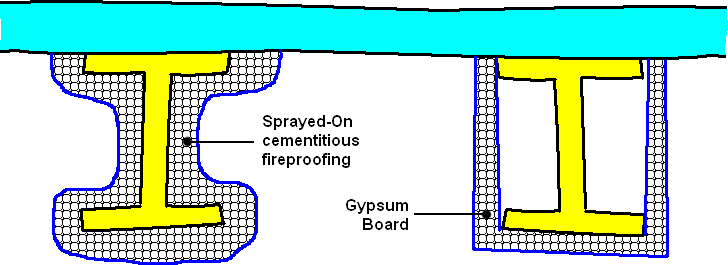
Fireproofing is employed in refineries and petrochemical plants to minimize the escalation of a fire that would occur with the failure of structural supports and the overheating of pressure vessels. The damage that fire could potentially do very early on, could add significant fuel to the fire.The purpose of fireproofing therefore, is to buy time. The traditional method of fireproofing has been poured-in-place concrete or gunite. Other fireproofing materials, such as lightweight cements, prefabricated cementitious board, and intumescent coatings are used to a lesser extent, primarily in areas deemed less critical and where weight reduction is a significant benefit.

Why Fireproofing is used
?Typically, fireproofing is designed to protect the structural steel which supports high risk or valuable equipment. The failure point is generally considered to be 1000°F, as this is the point where steel has lost approximately 50% of its structural strength. The aim then, is to prevent structural steel from reaching 1000°F for some period of time. Tanks, pressure vessels, and heat exchangers may experience a significant cooling effect from liquid contents and so, less fireproofing protection is generally required. Some thermal insulation systems may serve a dual role as fireproofing and this is common with some pressure vessels. Piping may be insulated but it isnot generally considered to be fireproofed.

Fireproofing needs to be durable to survive the rigors of every day life in the plant so that if and when a fire does occur, the fire endurance properties have been maintained and the fireproofing can be depended on to function satisfactorily. Everyday exposure may involve mechanical abuse, exposure to oil, solvents, and chemicals, and outdoor weathering for prolonged periods of twenty, thirty, forty years or more. As a coating for steel, fireproofing may provide a good measure of corrosion protection. 

When applied directly to steel, concrete may passivate the steel surface by providing an elevated pH. Experience has shown, however, that passivation is less than certain, especially in coastal marine environments. Corrosion under concrete fireproofing can be significant. Intumescent coatings promise better corrosion protection than concrete by virtue of their low permeability but cases of severe corrosion under fireproofing (CUF) have been reported with these materials.

Intumescent epoxies are complex proprietary materials. Concrete and some of the other materials that are used for fire protection are more familiar. The materials themselves may seem simple, but the important details of system design are often overlooked.

Source:http://www.wermac.org/materials/fireproofing.html
x

Wednesday, June 24, 2015

Thermal spray coatings to protect refineries

The problem of corrosion under insulation (CUI), which is common in the oil refineries industry, can be controlled by applying a thermal spray that is available from wear, corrosion and hardfacing company.

Thermal spraying techniques involve a coating process, whereby a melted material is sprayed onto a surface to coat it. Other industries that can also benefit from using the thermal spray include the refining, petrochemicals, power, industrial, onshore and offshore industries. CUI is difficult to locate owing to the insulation cover that masks the corrosion problem, often to a point where it would be costly to fix. The problem occurs on carbon steels and 300-series stainless steels. On carbon steels, CUI manifests as generalised or localised wall loss; with stainless pipes it is often pitting and corrosion-induced stress cracking. Though failure can occur in a broad band of temperatures, corrosion becomes a significant concern in steel at temperatures between 0 ºC and 149 ºC, but is most severe at about 93 ºC.

Corrosion and corrosion-induced stress cracking rarely occur when operating temperatures are constantly greater than 149 ºC. The cause of CUI is water ingress into the insulation, which traps the water – like a sponge – in contact with the metal surface. The water can originate from rainfall, leakages, deluge system water, wash water or sweating from temperature cycles or low temperature operation, as in refrigeration units. It is also widely known that the results of CUI are costly, with the problem accounting for as much as 40% to 60% of a company’s piping maintenance costs. 

CUI can result in repairs running into millions of rands and leading to significant plant downtime. The bulk of studies conducted on CUI involves all forms of corrosion and their associated costs, without providing the individual cost of corrosion related to insulation. A study completed in 2001 by a US research team of corrosion specialists reported the direct cost of CUI to be $276-billion a year, with that number potentially doubling when indirect costs are also considered. Solutions In recent years, the CUI prevention philosophy of many large petrochemicals companies has been based on the inspection-free, maintenance-free concept. Insulated systems – particularly piping systems – are expected to have a service life of 25 to 30 years. Evaluation of life-cycle savings has led to consideration of new, simple approaches to preventing CUI. 

All thermal spraying processes rely on the same principle of heating a feedstock: accelerating it to a high velocity, and then allowing the particles to strike the substrate. The particles will deform and freeze onto the substrate. The coating is formed when millions of particles are deposited on top of one another. With thermal spray aluminium (TSA), the particles are bonded to the substrate mechanically. The first step of any coating process is surface preparation, whereby surfaces are cleaned with a process that involves white-metal-grit-blasting the surface to be coated. Masking techniques may be adopted for components that only need specific areas to be coated. The second step is to atomise the aluminium, which is done by introducing the feedstock material into the heat source. The heat source may be produced by either chemical reaction (combustion) or electrical power (twin-wire arc spray). 

Next, the particles are accelerated to the substrate by the gas stream and deform on impact to make a coating. Finally, the coatings are inspected and assessed for quality by mechanical or microstructural evaluation. The two common thermal spray techniques used to apply TSA to components are wire flame spray and twin-wire electric arc spray. Adhesion to the substrate is considered largely mechanical and is dependent on the work piece being clean and suitably rough. Roughening is carried out by grit blasting to a white metal condition with a sharp, angular profile in the 50 μm to 100 μm range. Flame and arc spraying require relatively low capital investment and are portable; they are often applied in open workshops and on site. Consumables used for TSA with these processes are more than 99%-purity aluminium wires.

Source: http://www.engineeringnews.co.za/article/thermal-spray-coatings-to-protect-refineries-2014-09-05


Tuesday, June 16, 2015

Radiation Backscatter-Based Nondestructive Technology Detects Corrosion under Insulation on Offshore Oil and Gas Platforms

One of the most common forms of corrosion found in the offshore oil and gas industry is corrosion under insulation (CUI). Many components on offshore platforms, such as piping systems, pressure vessels, tanks, and other equipment, are insulated for personnel protection and/or to keep fluids at appropriate temperatures for process efficiency. When insulated equipment is exposed to the harsh offshore marine environment (salt spray and mist), the ingress of chloride-laden moisture into the insulating material renders the underlying metal substrate vulnerable to accelerated localized corrosion, which often goes undetected.

According to Danny Constantinis, CEO of EM&I Group, BCT allows inspection of the internal and external wall surfaces of any size pipe and vessel with multiple layers of various overlay materials, such as protective cladding and insulation or cementitious passive fire protection coatings, with accuracy that is comparable to ultrasonic testing. The single-side tomographic inspection technology is similar to a medical computerized tomography (CT) scan, where narrow beams of radiation are discharged into an object and captured by a detector that sends the data to a computer to generate an image of the inside of the object. 

Unlike a CT scan, where the object to be imaged is placed inside the scanner and transmitted radiation is measured, a BCT scan creates an image by clamping the scanner onto the exterior of the object to be evaluated and measuring the backscattered (reflected) radiation. The scanner moves a focused beam of gamma radiation across the targeted inspection area, which is about as wide as the scanner and a few centimeters tall. Basically, Constantinis explains, as the beam of radiation passes through the insulation covering the object, the radiation collides with the material’s molecules. 

These collisions throw off tiny photons that bounce back toward a bank of gamma radiation detectors built into the scanner. As the radiation travels further and penetrates the steel, which is denser than the insulation, a greater number of photons are reflected back. The distance of the reflected photons is measured by the scanner, and the resulting measurements are processed by the accompanying computer program, which calculates the density of the materials and constructs a computer-generated, cross-sectional image that depicts the insulation and the outside diameter (OD) and the inside diameter (ID) of the steel wall, and provides a quantitative wall thickness measurement. Any diminishing thickness of the OD or ID surfaces can be identified. This enables any insulated pipe or pressure vessel, regardless of its size, to be inspected for CUI through the insulation material. 

The technology has been tested and validated in several field trials since 2010, including a study at ExxonMobil’s Goldboro natural gas processing facility in Canada, where the BCT system was evaluated for its ability to identify CUI and internal wall thickness variations of large insulated pipes and vessels, Constantinis says. A separate offshore study was also conducted using coupons to assess the technology’s capability to gauge wall thickness. 

Source:http://www.nacemp.com/articles/material-selection-design/2015/08/radiation-backscatter-based-nondestructive-technology-detects-corrosion-under-insulation-on-offshore-oil-and-gas-platforms

Thursday, June 4, 2015

News: Pipeline In Santa Barbara Spill Was Corroded

LOS ANGELES (AP) — Two weeks before an oil pipeline rupture spilled over 100,000 gallons of crude on the Santa Barbara coast, a test was run that would reveal serious wear in that stretch of
corroded pipe.

Preliminary results showing the pipe lost nearly half the metal near the break vastly underestimated just how thin the pipe had become. Federal regulators said Wednesday that examination indicated more than 80 percent of the pipe had worn down.

The new finding does not pinpoint the cause of the May 19 rupture, but it exposes possible short-comings with the technology used to gauge pipe reliability and with those who analyze the results.

Whether a more accurate test could have prevented the spill seems unlikely because Plains All American Pipeline, which operates the pipe, said it had not received the results at the time of the spill. It typically takes several weeks to analyze data from high-tech instruments that can gauge the thickness of pipe walls, detect cracks and measure internal and external corrosion.

The instrument known as a smart pig, however, has limits.

"The smart pig term is an oxymoron," said Robert Bea, civil engineering professor emeritus at the University of California, Berkeley, who has worked three decades with the pipeline industry. "As you may guess, the primary weaknesses show up in the human interpretation. They're only as smart as the people who are interpreting the signals."

Between the analysis of the smart pig data and decision-making based on those results, such as whether a company should repair or replace compromised sections of pipe, human error accounts for 80 percent of breakdowns, Bea said.

In one study Bea conducted, a man interpreting test results missed a defect and the pipe later failed under pressure. The day before he analyzed the results, the man's wife had told him she was leaving him.

"His mind was elsewhere," Bea said.

The Pipeline and Hazardous Materials Safety Administration offered no explanation for the vast differences between the preliminary finding from May 5 that the pipe wall lost 45 percent of its metal and what inspectors learned when they looked at the pipe and found it was worn down to 1/16 of an inch in the area of the 6-inch-long break on the bottom of the pipe.

That discrepancy surprised Bea and other experts, and Plains officials noted it in a statement.

The company said it was committed to working with federal investigators "to understand the differences between these preliminary findings, to determine why the corrosion developed and to determine the cause of the incident."

Federal, state and local prosecutors are investigating the spill. California Attorney General Kamala Harris said Thursday during a tour of the site that she was troubled by the latest report and criminal charges were possible.

Plains has no timetable for restarting the line and has not provided an estimate for cleanup costs to date. It has apologized for the spill that has soiled 60 miles of scenic coastline and said it would bear all costs. A commercial fisherman has filed a federal lawsuit seeking class-action certification for affected businesses.

The nearly 11-mile pipeline runs through a coastal area with conditions known to cause accelerated corrosion. The villains are salt and moisture from the nearby Pacific Ocean, which can mix with soil.

The rate of corrosion is also influenced by temperature — the hotter the conditions, generally the greater likelihood of corrosion. The insulated pipeline operated at up to 120 degrees.

Temperatures in that range can also cause challenges for a key strategy to ward off corrosion, known as cathodic protection, a low-level electric current that is run through the pipeline.

A stronger level would be needed to offset the increased risk of corrosion at the higher temperatures.

Kevin Garrity, executive vice president for the Mears Group, corrosion engineering experts who work with the oil industry, said the level of metal loss at the site of the pipeline break was roughly 10 times greater than what would be expected with cathodic protection in place.

Federal regulators said Wednesday that the current levels for the system "appeared to be adequate." However, the agency also said corrosion "would not be expected" with the system running at that level, posing another riddle.

The report noted that the area that failed was close to three repairs made because of corrosion found in 2012 inspections. It also said the smart pig tests revealed that three other sections of pipe had extensive corrosion with metal loss ranging from 54 percent to 74 percent.

"Those devices are not 100 percent," said Don Deaver, a former Exxon pipeline engineer who now works as a consultant and expert witness, primarily for plaintiffs. "When you have an area where you have a lot of corrosion, the error in those smart pigs goes up dramatically."

Source:http://www.huffingtonpost.com/2015/06/03/pipeline-that-spilled-oil_n_7507030.html

Happy Deepavali

The festival of light is here! May you be the happiest and may love be always with you. Happy Deepavali!