Thursday, September 18, 2014

COATING APPLICATION "DO'S AND DON'TS"

Do's and Don'ts 

Even the right coatings are often doomed to failure before they are applied.  There are many reasons for this, such as:


  • Over reliance on the contractor.  Plants usually do not employ anyone with this specialty expertise and so there is an over-reliance on the contractor for coating material selection and specification writing.  Although many industrial coating contractors are sufficiently  knowledgeable regarding correct surface preparation and coating application, the contractor usually does not have adequate background or knowledge of how the equipment will operate, what the specific jobsite scenario will involve, and the condition of the steel surfaces to receive the coating.
  • Lack of information on the equipment condition and anticipated range of operating temperature.  Is the steel surface heavily corroded or pitted?  Will it be in cyclic or intermittent service?  Will it operate below the dewpoint?   
  • Lack of information regarding on-site restrictions on methods of surface preparation.  Will dry abrasive blasting be allowed?  What means of protection from grit and dust would allow use of abrasive blasting?  What is the cost of this? 
  • Lack of a detailed written coating specification  
  • Lack of a pre-job meeting where all parties review the specification and come to agreement on timing, scope, materials, method(s) of surface preparation, method(s) of coating  application, special needs regarding protection from weather, special needs regarding work on vessel or piping while in operation, inspection hold points 
  • Lack of third party inspection

All of these details can result in confusion on the contractor's part, improper selection of the coating material, improper surface preparation and coating application, or all of these.  We have found that problems result most often from inadequate flow of information and details.  Plant personnel often do not understand what details are necessary to draft the specification, nor is there typically the correct expertise readily available to gather the information, select the proper coating material and draft the specification

Source:http://wenku.baidu.com/view/9307622a915f804d2b16c1c2

Monday, September 15, 2014

Signs and Symptoms

Corrosion is perhaps one of the more obvious signs of plant ageing because of visible signs of corrosion product, either external or internally within equipment. The nature of many materials, especially carbon and low alloy steels, is to react with the environment by a corrosion process to attain a more stable condition, e.g. metallic iron “wants” to become iron ore again.

Many equipment items take account of this in the design process e.g. corrosion allowance so it is important to note that the presence of corrosion products, i.e. rust, does not indicate that equipment is not fit for its service. Rust is merely a sign that the equipment is ageing. The rate of this ageing process and its importance in risk terms are parameters the plant operator should be concerned with.

Susceptibility 

All metallic materials are susceptible to corrosion and/or corrosion cracking. Materials termed
“corrosion resistant alloys” or CRAs are less susceptible but not immune. This class nof materials are protected by a corrosion process that forms a thin layer of metal oxide at the  surface. Should the layer be damaged in an environment that does not support re-oxidation, then the material can become susceptible to corrosive attack.

Management Options 

Corrosion can be prevented or monitored and controlled. Prevention methods include 
coatings and/or cathodic protection (often termed “CP”). CP can be achieved either by the 
use of impressed currents or by connection of sacrificial anodes typically made from zinc or 
aluminium blocks. If coatings are used there should be evidence of coatings inspection and 
if CP is employed evidence of maintenance and monitoring of CP effectiveness should be 
available. 

For monitoring and control, management of corrosion is achieved through the following 
processes: 

• Identification 
• Detection 
• Quantification 
• Assessment 

Identification usually involves a risk assessment, e.g. RBI plan or may take the form of asset 
registers arranged to identify those equipment items that are expected to corrode in one way 
or another. Detection is the application of a suitable inspection technique, often visual, that can locate the corrosion. 

Quantification is achieved by measuring the remaining thickness of material available to 
contribute to the overall structural integrity of the equipment. In some instances, engineering 
judgement is applied but this should be documented to a sufficient extent that reasonable 
next inspection intervals can be deduced. 

Source:http://www.hse.gov.uk/offshore/ageing/ageing-plant-summary-guide.pdf

Wednesday, September 10, 2014

Specific Types of Common Corrosion

Carbon Dioxide (Sweet) Corrosion 

Carbon dioxide dissolves in water to form carbonic acid which causes what is known as
sweet corrosion. The product of this form of corrosion is iron carbonate which forms as a film
on the metal surface. At higher temperatures (+80oC) this film has protective qualities leading
to lower than expected corrosion rates at higher temperatures. Sweet corrosion is typically
observed as metal wall thinning and shallow pitting. Under high velocity conditions deep
elongated pits are sometimes observed.

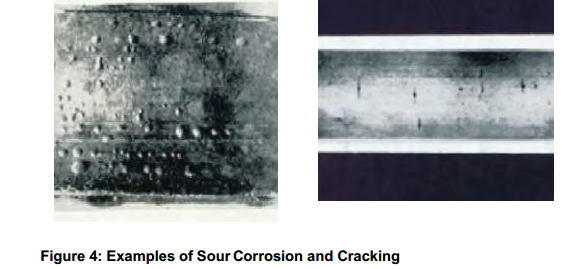
Hydrogen Sulphide (Sour) Corrosion 

Hydrogen Sulphide dissolves in water to cause what is known as sour corrosion. The product
of this form of corrosion is iron sulphide. The low solubility of iron sulphide in water results in
the formation of a dark or black corrosion product film that is able to protect the steel surface
from general corrosion even in aggressive systems. However due to the conductive nature of
the protective film any local break in the iron sulphide layer can result in very severe pitting.

Hydrogen sulphide may also cause hydrogen damage in susceptible steels. The reaction
which gives rise to the iron sulphide film releases atomic hydrogen which can then diffuse
into the steel where it can lead to the formation of hydrogen blisters or through wall cracking
(Sulphide Stress Corrosion Cracking or Stress Oriented Hydrogen Induced Cracking).


Microbial Corrosion 

Microbial corrosion is caused by the action of bacteria contaminated systems, commonly sulphate reducing bacteria (SRB’s). It is not the bacteria themselves that attack the metal but the local environments that they create and contribute to that leads to corrosion of the structure. Microbial corrosion is typically a problem inside pipes which are left with stagnant water, at dead legs and in the bottom of tanks. For microbial corrosion to occur conditions must be suitable to support bacterial life. These requirements include: 
  • Presence of bacterial life in the system. 
  •  Source of Sulphate. 
  • Source of Carbon. 
  • Source of water. 
  • Anaerobic conditions. 
  • Close to Neutral pH. 
  • Suitable temperature and pressure for bacterial life to be sustained. 

Atmospheric Corrosion 

Moisture, oxygen and aggressive species such as sulphate, nitrates and chlorides present in 
the atmosphere can lead to atmospheric corrosion occurring on exposed structures. 
Atmospheric corrosion proceeds under the same mechanism as wet corrosion however as a 
bulk liquid phase is only present during rainfall the corrosion reactions proceed in a thin film 
of condensed or absorbed moisture on the metal surface. 

The major factors that affect the rate of atmospheric corrosion at a given location are the 
moisture levels and the concentrations of aggressive species in the environment. Marine 
environments for example with high levels of chlorides present would exhibit significantly 
greater corrosion rates than inland environments with low levels of chloride. Similarly 
exposed metal structures in industrial locations with high levels of pollution and therefore 
higher levels of sulphates and nitrates than rural locations would record higher atmospheric 
corrosion rates than would be observed in rural locations. 


Source:http://www.hse.gov.uk/offshore/ageing/ageing-plant-summary-guide.pdf

Monday, September 8, 2014

Common forms of localised offshore corrosion

Pitting corrosion 

Pitting is an extremely localised form of attack where the wall loss is confined to a very small
area of the surface. The conditions within the pit can quickly become increasingly aggressive
causing corrosion pits to rapidly advance through the wall thickness whilst the vast majority
of the pipe or vessel wall remains unaffected. This can lead to very rapid failures as the pit
quickly penetrates the wall. This form of attack is one of the main forms of corrosion
observed in corrosion resistant alloys, however it is also found with corrosion of carbon
steels.

Crevice corrosion 

Crevice corrosion is similar to pitting corrosion, in that it is likely to be observed under the
same environmental conditions that have given rise to pitting. In crevice corrosion the area of
localised attack is found within crevices which typically form around and under washers, bolts
and seals. The solution within the trapped pocket can become increasingly aggressive and
significant localised attack can occur around the crevice.

Galvanic corrosion 

Galvanic corrosion occurs at the junction of two dissimilar metals which are in electrical
contact with each other. According to their relative positions within the galvanic series one
metal will be protected from corrosion at the expense of the other. Depending on the relative
surface areas of each metal this form of corrosion can proceed extremely quickly. If the
cathodic metal is much larger than the anodic metal surface then the observed corrosion
rates can be extremely high as a large cathodic area is driving corrosion at a relatively small
anodic point.


Source:http://www.hse.gov.uk/offshore/ageing/ageing-plant-summary-guide.pdf

Wednesday, September 3, 2014

Type of CUI inspections: Pulsed Eddy-Current (PEC)

Assessing condition of pipework and pressure vessels under insulation can be advantageous to plant operators. The Pulse Eddy Current (PEC)  system was developed as a solution to the detection of corrosion under insulation (CUI) and validated by Shell Global Solutions.

Compared with conventional eddy-current testing, pulsed eddy-current inspection requires no direct contact with the object being tested. Measurements can be made through any material not conducting electricity including coatings, insulation materials, weather sheeting and even corrosion
products. It is a very useful characteristic that also enables high temperature non-destructive testing (NDT) inspections.

Inspection approach

The PEC instrument probe is placed against the metal weather sheeting (non-ferrous) of the insulated pipe or vessel. The geometry of the test object should be simple. A magnetic field is created by placing an electrical current in the transmitting coil of the probe. This field penetrates through the weather sheeting and magnetizes the pipe wall. The electrical current in the transmission coil is then
switched off, causing a sudden drop in the magnetic field.As a result of electromagnetic induction, eddy-currents will be generated in the pipe wall. The eddy-currents diffuse inwards and decrease in strength. The rate of decrease of the eddy currents is monitored by the PEC probe and is used to
determine the wall thickness.

Comparison with ultrasound wall thickness measurement

Both pulsed eddy-current and ultrasound wall thickness measurement have strong and weak points. The relevance of these strengths and weaknesses varies greatly from application to application.


Benefits at a glance

  • ƒNo loss of production, as inspection can take place while the inspection object is in service.
  • ƒReduced inspection costs, as insulation material does not need to be removed.
  • Significantly lowered costs for underwater inspections.
  • Speedy inspection, as surfaces do not require any preparation.
  • Good reproducibility of PEC readings at the same locations.
  • Plus minus 10% accuracy for corrosion detection under insulation and only plus minus 0.2% accuracy for corrosion monitoring.
  • Inspections within a temperature range from -100°C to 550°C (-150°F to 1000°F).
  • Inspection of objects with a wall thickness of 3 to 35 millimeter.
  • Inspection of objects with a pipe diameter above 75 millimeter.
Areas for application

Pulsed eddy-current can be effectively applied for corrosion 
monitoring and detection on pipes and vessels made of 
carbon steel or low-alloy steel without making contact with 
the steel surface itself.
ƒInsulated and/or coated equipments
  • ƒ Objects under high temperature conditions
  • ƒ Heavy corroded equipments
  • ƒ Offshore risers and caissons
  • ƒ Objects behind concrete fireproofing
  • ƒ Laminations
  • ƒ Annular rings
  • ƒ Bridges

Source: http://www.tuv.com/media/corporate/industrial_service/NDT_Pulsed_Eddy_Current_TUV_Rheinland.pdf

Wednesday, August 27, 2014

Refinery And Petrochemicals Integrated Development (RAPID) Project

Project Description

RAPID aims at building a world-scale integrated refinery and petrochemical complex.The proposed refinery will have a capacity of 300,000 barrels per standard day and will supply naphtha and liquid
petroleum gas feedstock for the RAPID petrochemical complex, as well as produce gasoline and diesel that meet European specifications.
The petrochemical units, on the other hand, will enhance the value of the olefinic streams coming from the RAPID steam cracker by producing various merchant grades petrochemicals products such as polyethylene, polypropylene, synthetic rubbers and other petrochemicals products.

Engineering and Construction

FEED Contract

Technip has been awarded a front-end engineering design (FEED) contract by PETRONAS for its proposed Refinery and Petrochemical Integrated Development (RAPID) project located in the state of Johor, Malaysia.

Technology Contract

CB&I was awarded a contract by PETRONAS for the license and engineering design work for five petrochemicals units. Lummus Technology will be providing technology for a world scale steam cracker complex comprising ethylene, butadiene, benzene, isobutylene and MTBE units.


Source: http://www.epcengineer.com/projects/details/2342/refinery-and-petrochemicals-integrated-development-rapid-project

Friday, August 22, 2014

Insulation is everywhere

Corrosion is undoubtedly one of the costliest problems facing industry today. Due to corrosion of piping and equipment under insulation many companies have to repair and/or replace major parts at a considerable cost, reported to run into billions of dollars annually. Clearly this considerably reduces the potential service life of industrial facilities. More frequently, essential shutdowns and overhauls impair plant efficiency, driving up operating costs.

Industrial plant insulation is everywhere. A medium-sized oil refinery contains 356 miles of insulated piping and more than 25 football fields worth 1.4 million ft² of insulated equipment, vessels and tanks. The plant temperature can easily exceed 1100°F, making insulation essential to protect people and maintain operational efficiency.

Prompt and proper maintenance
In many cases, insulation is not promptly or properly maintained,simply because it is not considered to be a risk. For years,industry has estimated that 10% to 30% of exposed insulation becomes damaged or missing within one to three years of installation. That percentage is likely to rise over time, depending on the operating environment and exposure to the elements. Many plant operators know that steam-generating capacity must be increased when it rains to continue to provide the heat the plant needs to operate efficiently.

Damaged insulation leads to increased heat losses and corrosion costs
The impact of damage can be substantial. In many cases, the actual reduction in heat loss is up to 40% more than expected. Damaged insulation cladding often allows water to penetrate into the insulation, which can cause corrosion. Costs due to corrosion,downtime and additional unanticipated energy losses are substantial. The costs of inspection and repair, which can often be carried out during operation, are negligible compared to the potential savings


Source:http://www.roxul.com/files/RX-NA_EN/pdf/Brochures%20and%20Sell%20Sheets/Industrial/Corrosion%20Under%20Insulation_web%20version.pdf

Happy Deepavali

The festival of light is here! May you be the happiest and may love be always with you. Happy Deepavali!